


Open Innovation, the Power of the Swarm and Why Creativity Matters in Policy
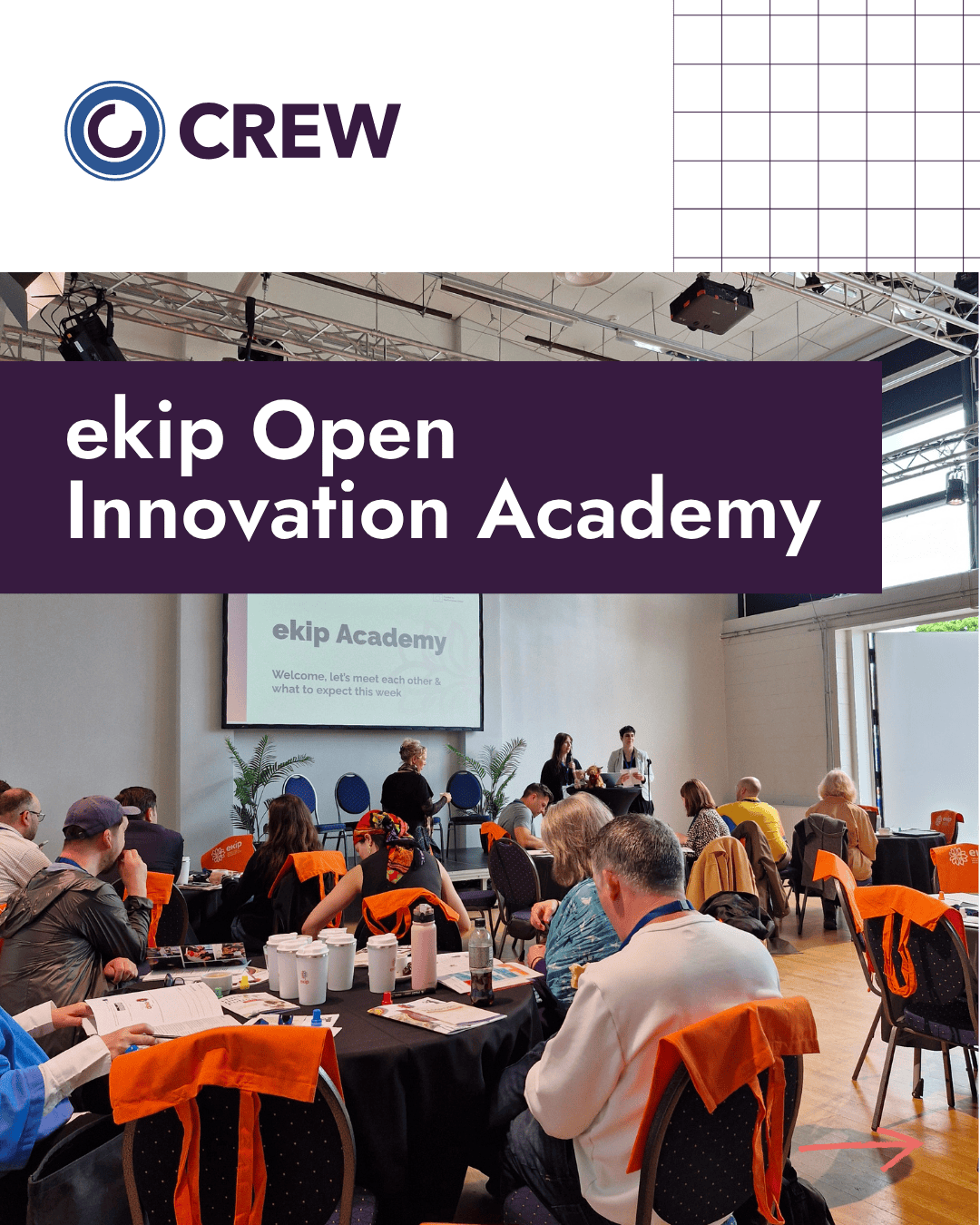
Earlier this month, CREW’s Director of Programmes and Projects, Ainslie Peters, had the opportunity to participate in the Open Innovation Academy hosted by ekip. We attended as part of a regional team alongside representatives from Galway City Council and the West Regional Enterprise Plan, creating an opportunity not only to explore new approaches to innovation, but to do so through the lens of place-based collaboration and regional development.
The academy brought together practitioners, policymakers and innovation leaders to examine how open innovation methodologies can support better policy and more effective responses to complex challenges. One of the strongest themes that emerged throughout the week was the role that creativity can play in shaping policy processes.
Too often, creativity is treated as something that happens at a particular moment in the process – during ideation workshops, stakeholder engagement sessions or consultations. The conversations during the ekip Academy reinforced a different perspective: creativity is not simply an input into policy development, it is a way of working that can strengthen every stage of the process.
From problem definition and evidence gathering to implementation and evaluation, creative approaches encourage collaboration, experimentation and comfort with ambiguity. They help us ask different questions, involve different voices and create space for solutions that are more adaptive, inclusive and resilient.
In many ways, policy making is (or at least should be) a creative act.
The Power of the Swarm
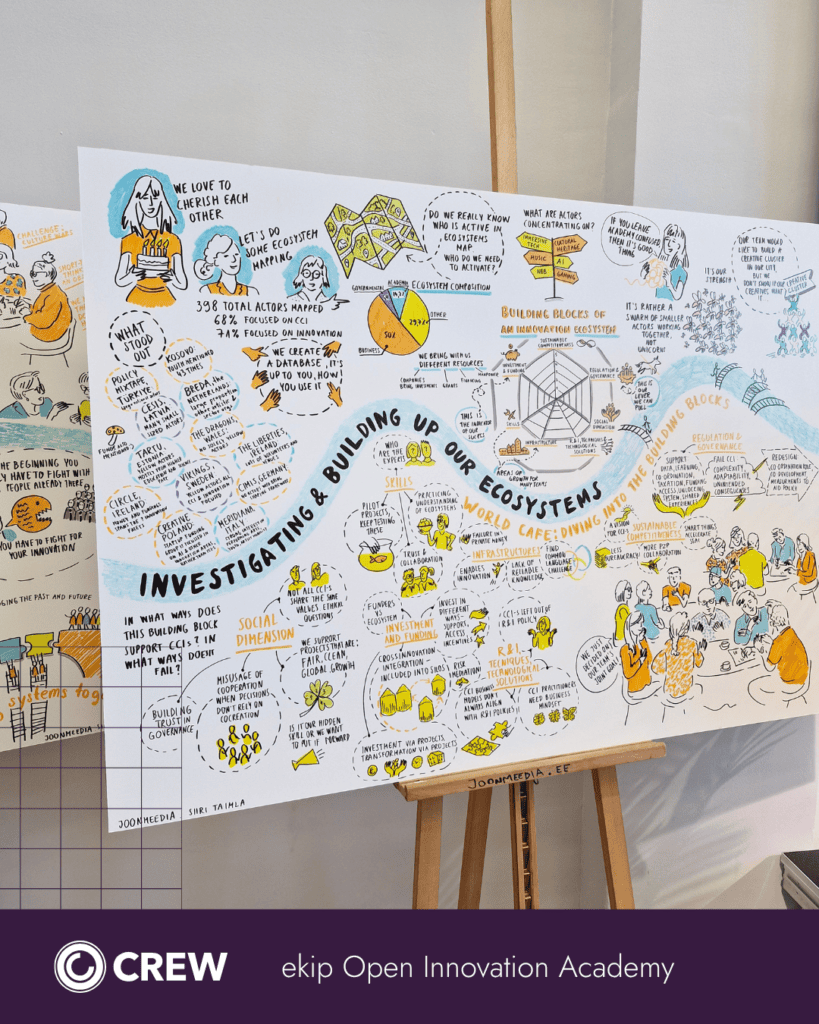
Perhaps the most powerful concept explored during the week was that of the “swarm” – the collective intelligence that exists within the creative and cultural sectors.
Innovation rarely arrives through the efforts of a single organisation or individual. Instead, it emerges through countless interactions and shared experiences across networks of creative practitioners, cultural organisations, researchers, entrepreneurs and citizens. It is this distributed creativity that gives our sector its remarkable ability to generate new approaches and respond to change.
We see this every day at CREW.
Many of the most valuable ideas, collaborations and opportunities emerge through connections across our community rather than through formal structures alone. Programmes such as CEED and CLIMB are designed around this principle. While they support individual founders and businesses, they also create the conditions for people to connect, share experiences, challenge assumptions and learn from one another.
The outcomes are often greater than any one participant could achieve alone.
This idea of fostering the swarm sits at the heart of CREW’s strategy, Where Creativity Means Business. Our ambition is not simply to support individual enterprises, but to strengthen the wider creative and digital ecosystem across the West of Ireland by connecting people, disciplines and organisations in ways that create new opportunities for innovation and growth.
Open Innovation in Practice
The academy also highlighted an important opportunity for the creative and cultural sectors.
Increasingly, governments and institutions are grappling with complex challenges that do not fit neatly within traditional policy processes. Climate transition, digital transformation, regional development and social inclusion all require new ways of thinking and new forms of collaboration.
The creative and cultural industries have a great deal to contribute to these conversations.
Creative practice is inherently collaborative, iterative and cross-disciplinary. It is comfortable with experimentation and uncertainty. These are precisely the capabilities that open innovation approaches seek to harness.
Rather than viewing the creative sector as a stakeholder to be consulted at a single point in time, there is an opportunity to recognise it as an active partner in designing and shaping policy responses.
Why This Matters for CREW
At CREW, we believe that creativity is an economic driver, a catalyst for innovation and a powerful tool for addressing complex challenges.
The conversations at the ekip Open Innovation Academy reinforced much of what we see through our own programmes and partnerships: better ideas emerge when diverse perspectives come together, and stronger outcomes are achieved when we invest in the networks and relationships that enable collaboration.
As we continue to deliver initiatives such as CEED, CLIMB and our wider regional activities, we are also focused on how the principles of open innovation and collective intelligence can be applied into wider policy and regional development conversations, amplifying the expertise and voice of the creative sector. The future of innovation lies in creating the conditions for the swarm to thrive.
And if we are serious about building more responsive, resilient and future-ready communities, then fostering that collective intelligence is not simply an opportunity for the creative and cultural sectors – it is something that should be central to how we approach innovation and policy development in the years ahead.